
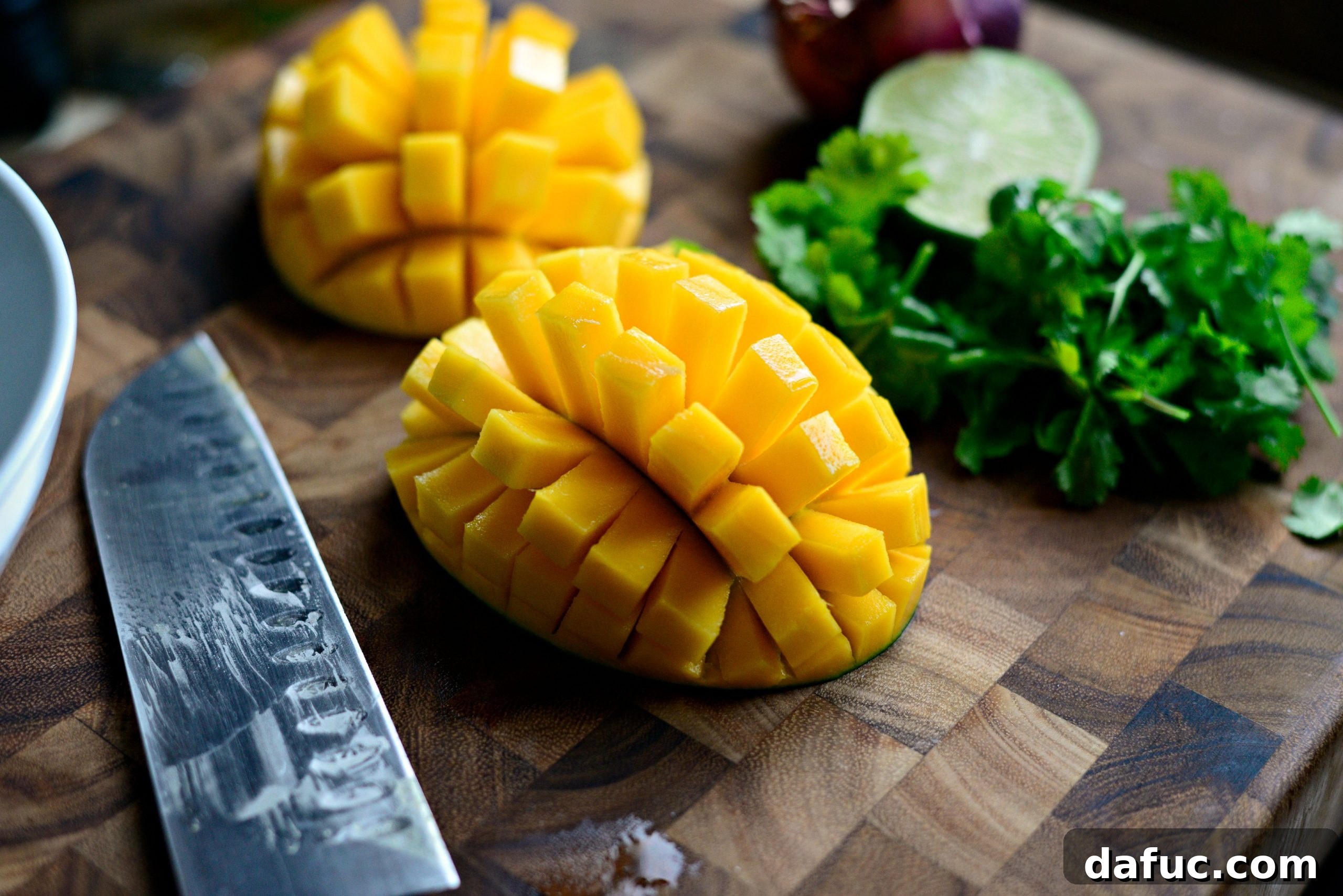
How to Perfectly Dice a Mango: An Easy Step-by-Step Guide
Mangoes, often called the “King of Fruits,” are celebrated globally for their vibrant flavor, juicy texture, and incredible versatility. Whether you’re craving a refreshing Pineapple Mango Smoothie, a zesty mango salsa to accompany your grilled dishes, a tropical addition to your salad, or simply a sweet snack, diced mango is a fantastic ingredient. While their irregular shape and large central pit might seem intimidating at first, learning how to properly dice a mango is an essential kitchen skill that’s surprisingly simple to master. This comprehensive guide will walk you through each step, ensuring you can effortlessly transform a whole mango into beautiful, uniform cubes ready for any culinary creation.

Why Master Mango Dicing?
Beyond the obvious aesthetic appeal, uniform mango dices ensure even cooking and distribution of flavor in your dishes. Dicing also makes mangoes easier to eat, especially in preparations like salads or salsas where a fork or spoon is used. It maximizes the amount of usable fruit, minimizing waste, which is particularly important with such a prized fruit. Once you understand the simple technique, you’ll be able to prepare mangoes quickly and efficiently, opening up a world of delicious possibilities for your healthy meals and treats.
Choosing the Perfect Mango: A Foundation for Success
The first step to a perfectly diced mango is selecting a ripe one. A ripe mango should yield slightly to gentle pressure, similar to an avocado or a peach. Don’t rely solely on color, as mango varieties come in various hues even when ripe – from green to yellow, red, or orange. Instead, focus on the feel and a sweet, fruity aroma emanating from the stem end. Avoid mangoes that are overly soft, bruised, or have a sour smell, as these may be overripe. Different varieties like Ataulfo (honey mangoes), Tommy Atkins, Haden, and Keitt each offer unique flavors and textures, but the dicing technique remains largely the same across the board.

Essential Tools for Mango Preparation
You’ll only need a few basic tools for dicing a mango:
- A Sharp Knife: The most crucial tool. A chef’s knife (8-10 inches) is excellent for larger mangoes and making initial cuts around the pit, providing leverage and control. For smaller mangoes, or if you prefer more precise, delicate cuts, a sharp paring knife (3-4 inches) can also be used effectively, especially for scooping the flesh.
- Cutting Board: A sturdy, non-slip cutting board is essential for safety.
- Bowl: To collect your delicious diced mango.
Knife Choice Matters: Chef’s Knife vs. Paring Knife
While the original recipe mentioned using a chef’s knife to simply “remove the fruit away from its skin,” a good quality, sharp chef’s knife is actually ideal for the primary cuts around the mango’s large, flat pit. Its length and weight make slicing through the dense fruit straightforward and controlled. However, if you’re aiming for very small, delicate cubes – perhaps for an intricate garnish or a very fine salsa – a paring knife can offer greater precision once the main sections of fruit are separated from the pit. Ultimately, choose the knife you feel most comfortable and safe handling. The key is that it’s sharp; a dull knife is more dangerous and less effective.
Step-by-Step Guide to Dicing a Mango
Step 1: Locate and Cut Around the Pit

The mango has a large, flat, oblong pit that runs vertically through the center of the fruit. To begin, stand the mango upright on your cutting board with the stem end facing up. Carefully slice downwards, about a quarter to a half-inch away from the center line, on one side of the pit. You should feel your knife resistance change once it hits the pit. Repeat this cut on the opposite side, creating two large “cheeks” of mango flesh. There will be a thinner strip of fruit remaining around the pit in the middle; don’t worry about this for now.
Pro Tip: If your mango is very slippery, use a damp paper towel to help grip it securely on the cutting board. Always cut away from your body.
Step 2: Score the Mango Flesh (Crosshatch Pattern)

Take one of the mango cheeks. With the skin side down, use your knife to make parallel slices through the flesh, from one end to the other. Be very careful not to cut through the mango skin. The goal is to create even strips of mango flesh. The closer your cuts, the smaller your final dices will be. Aim for about 1/2 to 1-inch intervals for standard dicing.

Now, rotate the mango cheek 90 degrees and make another set of parallel cuts, perpendicular to your first set. This will create a grid or “crosshatch” pattern on the mango flesh. Again, ensure you’re cutting only through the flesh and not piercing the skin. This step is crucial for achieving uniform cubes. You’ll now have a grid of mango cubes still attached to the skin.
Safety Note: Keep your fingers curled back to protect them from the blade as you make these internal cuts.
Step 3: “Hedgehog” the Mango and Slice Off the Cubes

Gently push the skin side of the scored mango cheek upwards from underneath, causing the diced flesh to pop out and invert, resembling a “hedgehog.” This makes it incredibly easy to remove the cubes. The mango pieces will now be proudly standing up, making them accessible.

With the mango hedgehog in hand, carefully slice the mango cubes off the skin directly into a waiting bowl. You can use the edge of your knife or a spoon for this. Be sure to scrape off any remaining bits of flesh near the skin.
Step 4: Repeat for the Other Half and Around the Pit
Repeat Steps 2 and 3 with the second mango cheek. Once both cheeks are diced, don’t forget the strip of fruit that was left around the pit. Carefully trim any remaining flesh from the pit using your paring knife, being mindful of the pit’s irregular shape. This extra flesh might not be perfectly diced, but it’s delicious for snacking or adding to smoothies.

And there you have it: perfect mango chunks! This method is efficient, safe, and results in beautifully uniform pieces, ready for immediate use.
Creative Uses for Your Diced Mango
Now that you’re a mango dicing pro, the culinary world is your oyster! Diced mango is incredibly versatile:
- Salads: Add a tropical twist to green salads, fruit salads, or grain bowls. Its sweetness beautifully balances savory ingredients.
- Salsas: Combine with red onion, cilantro, lime juice, and jalapeño for a vibrant mango salsa, perfect with fish, chicken, or tacos.
- Smoothies: Freeze diced mango for a convenient, healthy addition to your morning Pineapple Mango Smoothie or any blended drink.
- Desserts: Use in tarts, puddings, custards, or as a topping for yogurt and ice cream. Mango sticky rice, anyone?
- Breakfast: Stir into oatmeal, sprinkle over pancakes or waffles, or mix with granola and Greek yogurt.
- Savory Dishes: Incorporate into curries, stir-fries, or alongside roasted meats for a sweet and tangy contrast.
- Snacks: Simply enjoy a bowl of fresh, sweet mango cubes on their own.
Storing Diced Mango
Freshly diced mango is best enjoyed immediately. However, you can store it in an airtight container in the refrigerator for 2-3 days. For longer storage, flash-freeze the cubes by spreading them in a single layer on a baking sheet. Once frozen solid (after a few hours), transfer them to a freezer-safe bag or container. Frozen mango can last for several months and is perfect for smoothies and desserts.
Nutritional Benefits of Mangoes
Beyond their delicious taste, mangoes are a powerhouse of nutrition. They are an excellent source of Vitamin C, which is crucial for immune health, and Vitamin A, vital for vision. Mangoes also provide dietary fiber, aiding in digestion, and contain various antioxidants that can protect your cells from damage. Incorporating mangoes into your diet is a flavorful way to boost your nutrient intake.
Troubleshooting and Extra Tips
- Slippery Mango: If your mango is too ripe and slippery, you can lightly score the skin with a paring knife before making your main cuts around the pit to help with grip.
- Getting all the Flesh: Don’t be shy about scraping every last bit of flesh from the pit after the main cheeks are removed. It’s perfectly good to eat!
- Ripening Underripe Mangoes: If your mangoes aren’t quite ripe, you can leave them on your countertop at room temperature for a few days. To speed up the process, place them in a paper bag with an apple or banana.
Enjoy Your Perfectly Diced Mango! We hope this detailed guide empowers you to confidently dice mangoes for all your culinary adventures. If you give this “How To Dice Up A Mango” tutorial a try, we’d love to see your beautiful results! Snap a photo and tag us on Twitter or Instagram!
How to Dice a Mango (Quick Guide)
Learn how to dice up a mango for salads, salsa or freeze to add into your favorite smoothie recipe.

Print Recipe |
Pin Recipe
- Yield:
- 2 servings (1/2 a mango)
- Prep Time:
- 5 mins
- Total Time:
- 5 mins
Ingredients
- 1 fresh ripe mango
Instructions
- The mango has a thin pit that runs from top downward through the fruit. Use your knife to cut around that pit.
- Next make cuts through the fruit’s flesh but being careful not to cut through the skin.
- Make cuts going in the opposite direction, creating a crosshatch pattern.
- Gently flip the mango inside out to expose the cubes, then slice the mango cubes off of the skin and into a bowl.
- Repeat with the other half of the mango.
Nutrition Facts (per 1/2 mango serving)
- Calories: 101 kcal
- Carbohydrates: 25g
- Protein: 1g
- Fat: 1g
- Sodium: 2mg
- Fiber: 3g
- Sugar: 23g
- Author:
- Laurie McNamara
- Course:
- Kitchen Basics
- Cuisine:
- Universal